
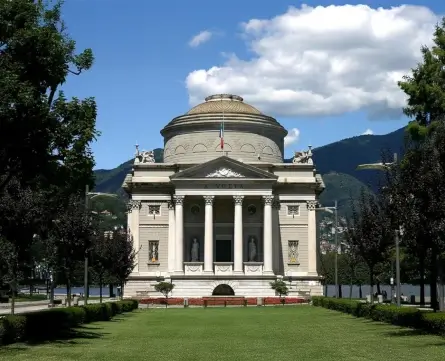
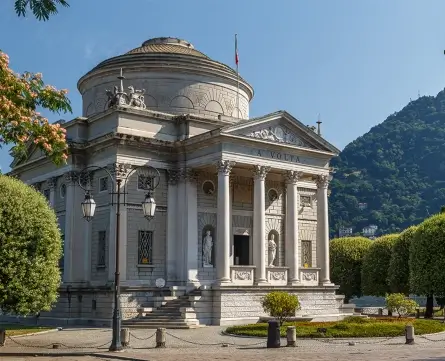

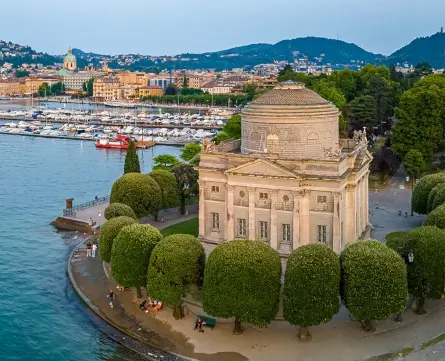
Tempio Voltiano is one of the four locations of the Civic Museums of Como. Inaugurated on July 16, 1928, it was conceived as a prestigious museum dedicated to preserving and displaying the original scientific instruments and reconstructions associated with the renowned scientist Alessandro Volta.
The idea, promotion, and funding for the construction of Tempio Voltiano came from entrepreneur Francesco Somaini, who donated the completed building to the city of Como.
The project was entrusted to architect Federico Frigerio, who designed the building in the Neoclassical style, drawing clear inspiration from the Pantheon in Rome. His intention was to create a monument worthy of the great scientist from Como, not only for the scientific and historical importance of its collections but also for its impressive architectural appearance.
The construction materials were carefully chosen to complement the museum’s design, including white limestone, magnificent polychrome marble flooring, and a large dome with a central opening that emphasizes the harmony and elegance of the interior space.
When Alessandro Volta died on March 5, 1827, he left behind an extraordinary legacy of scientific studies and instruments of immense historical and scientific value.
The exhibits at Tempio Voltiano include an extensive collection of scientific devices, machines, and instruments that allow visitors to explore the main subjects of Volta’s research and discoveries.
From the invention of the electric battery to his fundamental contributions to the study of electricity, gases, and their properties, the museum offers a fascinating journey through the scientific achievements of one of Italy’s most influential scientists.





Leave a Reply