
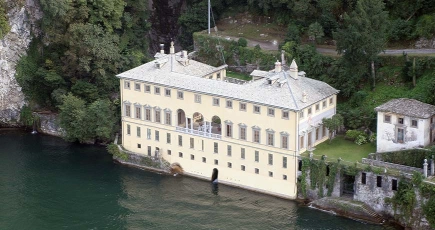
Villa Pliniana was built in 1577 by Count Giovanni Anguissola, Governor of Como.
In 1590, the governor’s nephew sold the villa to Pirro Visconti Borromeo, reportedly for a remarkably low price. Over the centuries, the villa welcomed many distinguished guests, including Napoleon, Lord Byron, Alessandro Volta, and Gioachino Rossini.
Throughout its history, the villa experienced periods of renewed splendor as well as long years of abandonment and decline. The English poet Percy Bysshe Shelley famously criticized its state of deterioration. Ownership changed hands several times until 1983, when the property was purchased by Società Pliniana, which began restoration work in May 2001.
Today, the villa’s interiors are largely devoid of their original furnishings, as the Valperga family removed the valuable furniture and decorations following the sale in 1983.
In the courtyard stands a statue of Neptune, the Roman god of the sea, seemingly celebrating the enduring fame of the Plinian spring, which has fascinated visitors for centuries.
Traces of the villa’s former grandeur can still be admired in its beautifully decorated coffered ceilings, painted friezes, mosaic floors featuring heraldic coats of arms, and magnificent Doric loggia, which offers breathtaking views of the southern basin of Lake Como.
The Intermittent Spring of Villa Pliniana
A remarkable natural phenomenon has made Torno famous throughout the world for centuries. At the heart of this phenomenon is a perennial spring that feeds the renowned Plinian Intermittent Spring, located within the villa of the same name.
The spring takes its name from Pliny the Elder and Pliny the Younger, who described it in their writings. In his Naturalis Historia, Pliny the Elder described it as an abundant spring whose water level continually rises and falls.
For centuries, scholars and scientists, including Leonardo da Vinci in the late 15th century, attempted to explain the mysterious behavior of this unusual spring.
According to the most widely accepted modern hypothesis, the phenomenon is caused by a natural siphon within a karst cavity. When the water inside the underground chamber reaches a certain level, it flows outward through the siphon, causing the discharge to increase. The flow then decreases until enough water accumulates inside the cavity to trigger the next cycle.


Leave a Reply